Why Your Business Needs a 7-Star LinkedIn Profile (And How I Build Them)

Michael Ellis • February 14, 2026

This is a subtitle for your new post


Why Your Business Needs a 7-Star LinkedIn Profile (And How I Build Them)


To All HR Recruiters and Hiring Managers:


What exactly does a LinkedIn 7-Star Profile Development Award signify? It’s more than just a badge; it’s a blueprint for digital authority.


The All-Star Framework


A "7-Star" developer is an expert who meticulously optimizes the seven core sections required to trigger LinkedIn's official All-Star status.


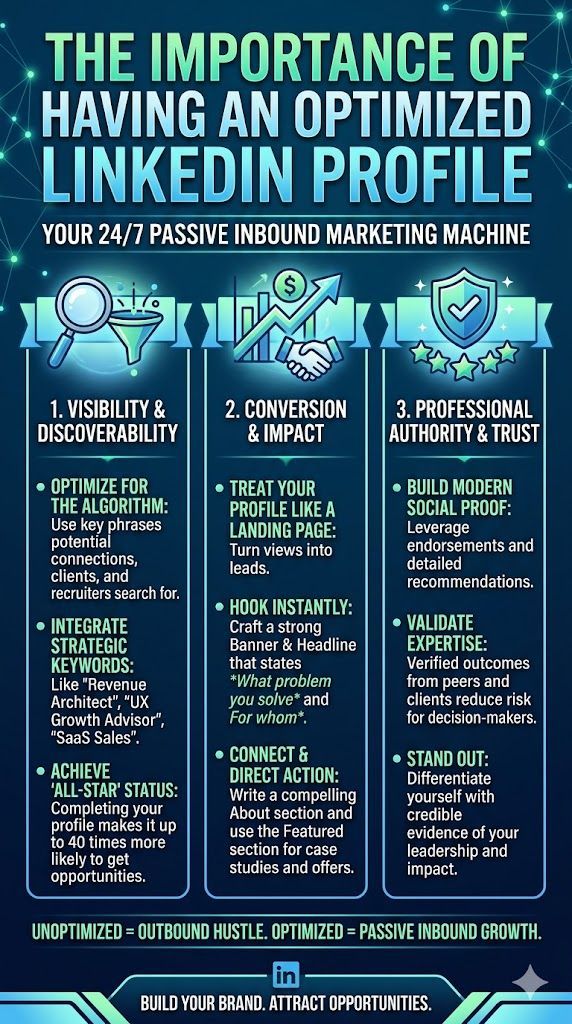
This status isn't just for show—the LinkedIn Help Center confirms that users with complete profiles are 40 times more likely to receive opportunities through search.


Your Profile is a Landing Page


I approach LinkedIn with the critical thinking of a conversion specialist.


According to the American Writers & Artists Institute (AWAI), a landing page is a highly concentrated web page designed for a targeted audience to sell a specific service or product.


By treating your profile as a high-converting landing page, we apply these key marketing principles:


The Single CTA: Just as a professional landing page has one Call to Action (CTA) to prevent distractions, your profile should guide visitors to one goal: "Message Me," "Book a Call," or "Visit My Portfolio."


Retention: The objective is to keep the viewer engaged until they take that desired action.


Search Intent: Just as visitors reach a landing page via PPC (Pay-Per-Click) ads or emails, recruiters find your profile via SEO-driven headlines and keywords.


When you work with a 7-Star developer, you aren't just filling out a form; you are building a lead-generation machine that works while you sleep.


Why the "Landing Page" Approach is Dominating 2026


In a digital landscape crowded with AI-generated noise, targeted messaging is the only way to cut through. Because every "7-Star" profile uses landing page logic, it naturally results in a higher response rate, more high-ticket conversions, and a stronger personal brand.


The Golden Key: The SEO-Driven Headline


The headline is the most critical piece of real estate on your profile. There must be absolute relevance between your headline and the search intent of the recruiter or client to generate a conversion.


If your headline doesn't hook them in the first 3 seconds, the rest of your profile doesn't matter.


The Investment: Why LinkedIn Development is a Steal


To understand the value of this service, look at what professional copywriters charge to build a traditional Landing Page Promotion:


Beginners: $3,500 – $5,000 + Royalties

Intermediate: $7,000 – $12,000 + Royalties

Expert Level: $25,000+ Plus Royalties


While my skills and experience sit at that Expert Level, applying these high-level copywriting principles to your LinkedIn profile provides the same conversion power at a fraction of the cost of a standalone sales site.


The 7-Star Framework for Authority


To reach official "All-Star" status and unlock the algorithm's reach, these seven dimensions must be completed with strategic precision:


Professional Headshot: Your first impression and trust-builder.


SEO Headline: Your primary keyword hook.


STAR-Method Summary: Your "About" section converted into a sales pitch.


Experience: Quantified achievements, not just job descriptions.


Skills & Endorsements: The social proof that validates your expertise.


Education: Establishing your foundational authority.


Industry & Location: Essential metadata for recruiter search filters.


SEO & Conversion Tips


Price Anchoring: By listing the high costs of general copywriting ($25k), your LinkedIn services feel like a high-value investment rather than an expense.


Formatting: I used a numbered list for the 7-Star Framework to improve Featured Snippet chances on Google and LinkedIn's internal search.


Internal Linking: In your live post, make sure to link "7-Star Framework" to your booking page or portfolio to mimic that Single CTA logic.


For a specialist like a 7-Star LinkedIn Profile Developer, building a profile is identical to engineering a high-performance landing page. In 2026, where "intentional engagement" is the primary algorithm driver, speed must be balanced with strategic depth.


Estimating Time for Each Phase


A high-converting landing page (or an All-Star LinkedIn profile) generally takes 8 hours to 3 days for a simple, focused build. 


Phase 

Simple Page (LinkedIn Profile)

High Complexity (Full Promo)


1. Planning & Strategy


1–3 Hours


1–10 Days


2. Content Creation (Copy)


2–4 Hours


1–7 Days


3. Design & Visuals


2–4 Hours


4 Hours – 7 Days


4. Development/Setup


1–2 Hours


4 Hours – 10 Days


5. Testing & Optimization


1 Hour


2 Hours – 3 Days


Phase Breakdown for a 7-Star Build


Phase 1: Discovery & Strategy


Before writing a single word, we identify your ICP (Ideal Customer Profile). For a LinkedIn profile, this means aligning your "landing page" with the specific search terms recruiters and clients use in 2026.


Phase 2: High-Impact Copywriting
This is where the STAR-method summaries and headlines are crafted. Expert-level copy focuses on
benefits over features—showing how you solve problems rather than just listing skills.


Phase 3: Visual Authority


We curate social proof and high-authority recommendations to establish professional credibility.


This includes selecting a "hero shot" (profile picture) and banner that mirrors a professional site's visual hierarchy.


Phase 4: Technical "All-Star" Implementation


Ensuring all seven dimensions are filled to trigger LinkedIn's
40x reach multiply.


Phase 5: The "Living Document" Test

A landing page is never finished.


We treat the profile as a living document, using A/B testing principles to tweak headlines or CTAs based on who is actually viewing your profile. 


To SEO-optimize this content, you must align the "7-Star" terminology with how recruiters actually search. LinkedIn officially uses "All-Star" status to denote a 100% complete profile. Since "7-Star" likely refers to the 7 specific sections required to reach All-Star status (Photo, Industry/Location, Education, Connections, Summary, Skills, and Experience), using both terms will capture more traffic. 


SEO-Optimized Version: The Recruiter Reality Check 


Target Keywords: LinkedIn All-Star Profile, Executive Recruitment, STAR Method, Profile Optimization, HR Hiring Bias.


To All HR Recruiters and Hiring Managers: How many candidates do you encounter who actually hold a LinkedIn All-Star Profile status?


The answer is likely near zero.


While many applicants have a "complete" profile, few have a conversion-engineered asset designed for Executive Search


In a sea of generic resumes, a 7-Star/All-Star profile stands out as a beacon of professional intentionality.


It signals that the candidate doesn't just "have experience"—they possess the communication skills and personal branding to market that experience effectively to Talent Acquisition teams. 


The Impact on Hiring Bias


How many times has 
implicit bias caused you to bypass a high-potential individual simply because their digital footprint was "unreadable"?. 


Implicit bias is a hurdle in every hiring cycle, but the STAR-method framework (Situation, Task, Action, Result) used in an optimized All-Star build is specifically designed to combat this.


By focusing on measurable outcomes and quantifiable data, it forces a shift from subjective "vibes" to objective, merit-based evaluation


Key Optimization Strategies


SEO-Optimized Version: The 7-Star ROI Advantage


Target Keywords: Candidate ROI, High-Impact LinkedIn Profile, Personal Branding for Executives, Recruitment Performance, Professional Value Proposition.


An optimized 7-Star profile forces a recruiter to look past the surface and focus on the tangible ROI a candidate brings to the table. In a competitive Executive Search, the data speaks louder than a title.


When a LinkedIn profile functions as a high-impact landing page, it doesn't just ask for a job—it proves professional value before the first interview even begins.


By utilizing quantifiable achievements and strategic keywords, the candidate transforms their digital presence from a passive resume into a lead-generation tool for their career.


By Michael Ellis June 2, 2026
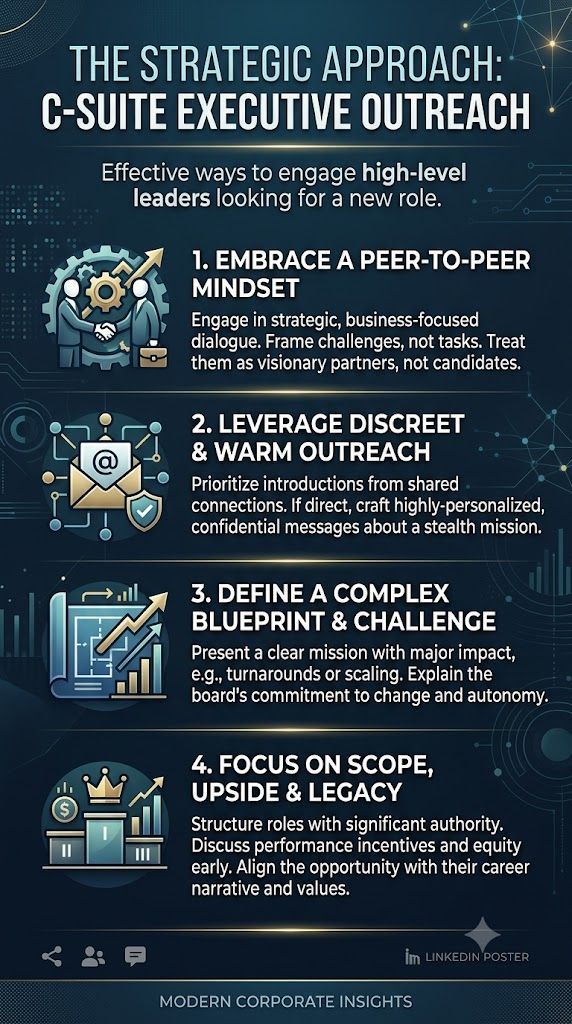
When you are operating at a strategic level, collaborating with other major decision-makers isn't just a networking exercise—it’s a massive force multiplier for revenue, risk management, and speed to market. When high-level leaders align, they stop reacting to the market and start shaping it. Here are the top 5 reasons to actively collaborate with other major decision-makers: 1. Radical Risk Mitigation When you operate in a silo, your blind spots are your biggest financial and operational liabilities. Other decision-makers bring entirely different datasets, regulatory experiences, and historical lessons to the table. By collaborating, you can pressure-test strategies before capital allocation, stress-testing ideas against a wider array of market variables and avoiding costly, unforced errors. 2. Accelerated Speed to Market Bureaucracy and misaligned priorities are the ultimate killers of velocity. When top-tier leaders collaborate directly, you bypass the friction of mid-level translation layers. Decisions that typically take months of back-and-forth emails can be synthesized, greenlit, and initiated in a single, high-alignment session. 3. Asymmetric Resource Integration Every organization has structural limitations, whether in proprietary data, distribution networks, specialized talent, or technological infrastructure. Collaborating with peer decision-makers allows for the creative pooling of these assets. This integration yields capabilities that neither party could build independently without massive, inefficient capital expenditures. 4. Cross-Pollination of Innovation True innovation rarely happens in a vacuum; it occurs at the intersection of different disciplines. When leaders from different sectors or distinct functional areas overlap, they bring unique operational frameworks.A psychology-driven communication strategy paired with a high-scale tech infrastructure, for instance, transforms how a product catches fire in the market. 5. Geometric Market Authority  When major decision-makers publicly align or co-develop initiatives, it sends a powerful signal to the industry. This joint authority acts as a trust accelerator. It commands immediate market attention, deepens client retention, and creates a defensive moat that makes it incredibly difficult for fragmented, lower-tier competitors to disrupt your positioning. The Bottom Line: Siloed leadership scales linearly. Collaborative leadership among major decision-makers scales geometrically.
By Michael Ellis June 2, 2026
This is a subtitle for your new post
By Michael Ellis June 2, 2026
Hello: Hiring Managers & Personal Whatever you're doing please stop. Pay Attention Pay Attention Pay Attention Have you ever searched for a product on the internet and read something like this: Meet the new [Phone Name]. Experience next-gen Agentic AI, a revolutionary pro-grade camera system, and all-day battery life. Buy yours today with free shipping! Get the new [Phone Name] at [Company Name]. Learn about specs, colors, and pricing. Plus, save up to $1,100 with an eligible trade-in for a limited time! Is the new [Phone Name] worth the upgrade? Read our in-depth review covering the upgraded AI features, real-world camera tests, and hidden pros and cons. These are called Meta-Descriptions. And Copywriters, and Brand Architects ( Strategist Create These). Do you see how detailed these meta-descriptions are? Now let's compare these samples to a flimsy job description. MET Fire Protection Discipline Manager (PE Reguired). Here's another bad example: Senior Mechanical Design Engineer-HVAC Listen people Top Talent Candidates are going to pass this Job offer by. Why? Because it lacks vital details. Want To Know How To Improve Your Job Descriptions? Reply IMPROVE & Fill Out The Consulting Form.
By Michael Ellis May 30, 2026
This is a subtitle for your new post
By Michael Ellis May 30, 2026
Stop guessing where your competitors are leaving millions on the table. 🛑 Most founders look at their rivals and copy their features, their pricing, or their design. That’s a fast track to becoming a second-rate commodity. If you want to unlock elite pricing and scale past your current revenue ceilings, you don’t copy them. You find the gaps in their architecture and exploit them. Introducing The Atomic Mastery Training Course. 🛡️ This is a bespoke, 4-week accelerated high-ticket consulting program designed exclusively for founders who are ready to stop guessing and start winning. You won't be handed a generic spreadsheet. You'll be taken through a rigorous, high-impact revenue audit to map out exactly where your market rivals are failing their customers—and how you can sweep in to claim that market share. You Can Gain The Edge Over Your Competitors The Available Training Courses Competitive Analysis SWOT Gap Analysis ROI Analysis P&L Analysis SWOT Analysis Impact Analysis Risk Analysis Cost-Benefit Analysis By the end of these 4 weeks, you will possess a tailored market blueprint to completely optimize your Unique Value Proposition (UVP), eliminate friction in your pipeline, and engineer a scroll-stopping messaging ecosystem that commands premium fees. No more copying the market. It’s time to lead it. Hurry! 🚨 APPLICATIONS CLOSE SOON. 🚨 We keep cohorts strictly capped to maintain high-touch, bespoke strategic consulting for every single founder inside. 👉 DM me the word "ATOMIC" for further information and let's see if your revenue system is ready for the leap.
By Michael Ellis May 30, 2026
Take A Look At This Interesting Conversation The Data Scraper Said: Sure, I completely understand your question about a legal contract. At the moment, we do not have a separate legal contract for the referral/partnership model. Our cooperation is based mainly on trust, transparency, and long-term business interest. For me, the main goal is not to save money on commissions. My goal is to grow the business and build long-term, mutually beneficial relationships with people who can bring good clients. For example, if a referral brings a client who pays $2,000, I am more than happy to pay the agreed commission. It would make no sense for me not to pay it, because by paying the commission I keep a good partner motivated, and that partner may bring more clients in the future. Not paying the commission would be a very short-sighted decision, because I would lose a valuable long-term partner. Also, if you reviewed how we usually work with clients, you probably saw that we do not ask for upfront payments in most cases. We usually build a demo first, show it to the client, and only after the client confirms that everything looks good, they pay. So we also take risks on our side. In general, my work is built on trust. When a new client comes to us and I spend time building a scraper, automation demo, or technical proof of concept without prepayment, I am already taking responsibility and trusting that the client will act fairly if the result is good. The same principle applies to partnerships. If you bring real clients and the project is successfully paid, I want you to earn your commission and continue working with us. My interest is to create a reliable referral relationship where everyone benefits: the client gets the solution, we get the project, and you get paid for bringing the opportunity. MY RESPONSE You can actually create one from the template I sent you. Why? Because in my experience in dealing with Confidential Angel Investors it's a basic requirement. You have to remember who you're dealing with here. These CEO's etc. are not going to take an offer without some form of legal contract. You can formulate one from the one I sent you. Or even Google it and use a Legal Contract Templa I mean do you think when one or more of these High-End Paying Clients buys a Rolls Royce, Bugatti, or a Billion Dollar Home or Commercial Property they don't sign a contract? Contracts Build Trust. Contracts Build Trust. Contracts Build Trust. All throughout history some form of a Contract Agreement was always involved in business. I will not present any kind of offer to my precious network without proper legal documentation. Win Win Situations Are Sealed Via Contracts, AKA Proper Party Signitures. And that's final. h ttps://lnkd.in/ezDiJWSb Free Referral Agreement with Downloadable Templatesignaturely.com
By Michael Ellis May 28, 2026
How To Track A ROI Model 
By Michael Ellis May 27, 2026
Is Your Resume Getting Ignored, or Just Unresponsive? Most resumes read like a boring list of daily chores. Recruiters don’t want to know what you did—they want to know what you achieved. If you want to turn a passive skim into an immediate interview callback, you need to master the CART Formula. This high-conversion resume cheat sheet is designed to transform your professional history into a high-yield revenue and impact story. The CART Formula Broken Down The CART framework forces you to anchor your experience in psychology, behavioral proof, and measurable ROI. [ Challenge] + [Action] + [ Result ] + [Tie In] 1. Challenge (The Context) What it is: The friction point, inefficiency, or business obstacle you inherited. The Psychology: Humans are hardwired to pay attention to conflict before resolution. Setting the stage makes your eventual success look massive. 2. Action (The Strategy) What it is: The precise, high-leverage initiative you designed and executed to solve the problem. The Psychology: Move away from passive verbs. Use authoritative, ownership-driven language (e.g., Architected, Engineered, Optimized) to showcase your unique methodology. 3. Result (The Proof) What it is: The hard, quantifiable data that proves your action worked. The Psychology: Numbers offer cognitive reassurance. Whether it’s dollars saved, revenue generated, or efficiency percentages scaled, metrics eliminate doubt. 4. Tie-in (The Alignment) What it is: The explicit link connecting your past victory directly to the goals of the company you are targeting next. Psychology: This is the missing link in 99% of resumes. It bridges the gap between "Look what I did there" and "Here is exactly how I will replicate this success for your SAAS brand." Before & After: The CART Transformation Look at how a standard, flat bullet point transforms when put through the CART architecture a repeatable framework for scaling enterprise SAAS revenue (Tie-in). Before (The Chore List): > "Responsible for managing the client onboarding process and improving retention." After (The CART Formula): > "Inherited a chaotic onboarding system causing a 35% churn rate (Challenge); architected a psychology-driven UX workflow (Action) that secured a $29M capital raise and 40% retention spike in Q4 (Result), proving. Stop leaving your career growth to chance. Get the exact, plug-and-play template designed to make your resume structurally undeniable to recruiters and hiring algorithms alike. Testimonial # 1 I'm so glad I contacted Michael. I went from being unemployed for 3 months to having 5 interviews. I'm smiling all the way to the bank. Now my Annually salary is $ 179.00 T.H. Cleveland OH. Testimonial # 2 Michael has a deep understanding of brand psychology. He showed me the gaps in my approach. After my next steps I received a call from a major SaaS company. My salary has increased to $ 393,000. D.V. Miami FL. Testimonial # 3 Wow. In all my years of experience as a Cognitive Psychologist I never heard of such a mind blowing method. Michael's framework skyrocketed my appointments by 79%. He also told me the secrets of The Gatekeeper Method. Now I'm calling on two other colleagues to help me with my workload. Ready To Get Started? Simply Use The Consulting Form Reply [ Transform My Resume Now ]
By Michael Ellis May 27, 2026
What Are The Best Employee Engagement Methods? That's the trillion dollar question. Did you know that between 2019 to 2024 (141.4 million people) walked off their jobs. The following Methods Listed below will help to prevent a repeat performance of the Great Walkout previously mentioned. 1. Radical Communication & Feedback Loops Trust cannot exist where communication is inconsistent or unidirectional. If employees feel left in the dark, they safely detach and just "go through the motions."(ContactMonkey) Implement Continuous, Two-Way Feedback: Ditch the heavy annual review as your primary tool. Transition to a continuous feedback model centered on structured, non-negotiable weekly or bi-weekly 1:1s.(Culture Amp) Close the Loop on Engagement Data: If you send out pulse surveys, you must share the aggregated results and the explicit action plan with the team. Collecting data and doing nothing with it actually lowers engagement faster than not asking at all. (Achievers) Context-Rich Leadership Updates: When changes happen, internal departments should focus heavily on the "why" behind decisions, helping teams connect their daily execution to larger organizational goals.(ContactMonkey) 2. Autonomy-Driven Growth Clarity People don't just want a job; they want to see a future. Disengagement often peaks when an employee feels stagnant or micromanaged. Map Personal Growth Plans (Not Just Job Paths): Work with employees to design custom internal mobility and upskilling pathways. Give them dedicated, protected hours each week to pursue learning—lack of time is the number one barrier to development.(Achievers) Optimize for Individual Strengths: Spend less time trying to fix minor weaknesses and more time positioning people where they naturally excel. Gallup’s data shows that employees who use their core strengths daily are significantly more engaged and less prone to burnout. The Successive Growth Framework: Shift the manager's role from a supervisor to a performance coach. Set clear, realistic, and measurable outcomes, then give the employee the creative freedom to figure out how to achieve them.(Achievers) 3. Real-Time, Specific Recognition Generic recognition feels hollow. To make appreciation a driver of success, it needs to be timely and tied to concrete actions.(Achievers) Decentralize Peer-to-Peer Recognition: Implement systems where team members can publicly call out wins across departments in real-time (whether via a dedicated Slack/Teams channel or a points-based recognition platform). (Culture Amp) Call Out the "Micro-Wins": Don't wait for a $2M deal to close to praise your team. Acknowledge the clean documentation, the swift resolution of a messy client issue, or a great save in a morning meeting.(Achievers) The Engagement Golden Rule: Employees thrive when they have absolute clarity on expectations, the exact tools to succeed, and a manager who treats them as a partner in growth—not a cog in a machine.
By Michael Ellis May 26, 2026
How Much Progress Have You Made In Solving This Major Problem '' Scaling Community- First Talent Recruitment? To: Chris Patrick HR Director of Carter Professional Care & Other Relevant HR Directors. Oklahoma City Oklahoma And Surrounding Areas From my experience as a Copywriting Solutions Architect & UX Growth Advisor, I’ve seen what happens when companies treat crucial talent acquisition like a simple checklist. The backbone of any rural health center is its people—both clinical and non-clinical. Yet, attracting high-quality physicians, Chief Nursing Officers (CNOs), and advanced practice providers to smaller, rural communities remains a constant, uphill hurdle. Let’s be honest: The old method of advertising these critical roles as just "jobs" is a tragedy waiting to happen. To save a community’s healthcare lifeline, you need a New Method—one rooted in high-impact, mission-driven storytelling that speaks directly to the purpose-driven professional. When you shift from job descriptions to personal missions, you don't just find people; you drastically optimize your entire talent acquisition pipeline: 1. Speed & Efficiency Metrics Accelerate your Time to Hire by cutting through the noise and capturing the right attention instantly. 2. Quality & Impact Metrics Elevate your Quality of Hire by attracting professionals who aren't just looking for a paycheck, but are looking to make an impact. 3. Financial & Sourcing Metrics Drastically lower your Cost per Hire by maximizing the organic reach and resonance of your sourcing channels. 4. Experience & Conversion Metrics Drive up your Offer Acceptance Rate by designing a candidate experience that feels less like an interview and more like an invitation to a legacy. The Bottom Line: While efficiency metrics like Time to Fill keep the doors open, balancing them with quality metrics like First-Year Attrition ensures you aren't just hiring quickly—you are hiring right. HR Directors: Your recruitment marketing needs to get stronger. The old playbook isn't cutting it anymore. I have the strategies ready to transform your outreach into high-performance revenue and retention systems. DM me directly or call 203-812-9082 (EST) to architect your new talent acquisition strategy.