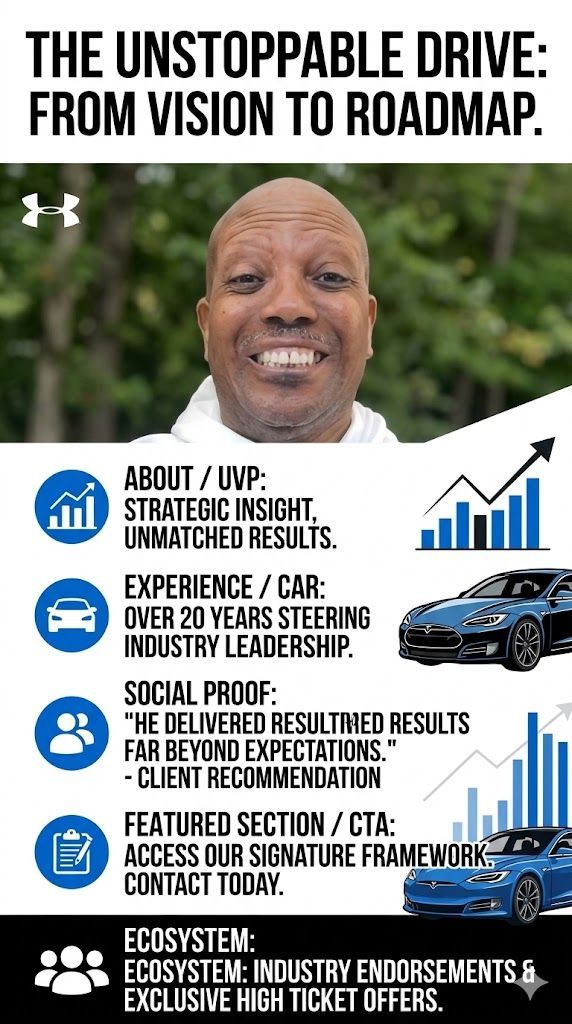


A Strategy Deck Analysis
This is a subtitle for your new post
A Strategy Deck Analyst
A high-level strategy deck serves as the blueprint for moving a business from its current state to a desired "Future State."
In direct-response and revenue architecture, the deck shouldn't just be informative—it must be persuasive.
Below is a standard 10-slide framework for a Growth & Revenue Strategy Deck, designed to align stakeholders and justify a strategic pivot.
Slide 1: The Executive Thesis
Title: [Project/Brand Name] Strategic Growth Roadmap
The Hook: A one-sentence distillation of the "Big Idea."
Objective: Define the primary goal (e.g., "Scaling to $10M ARR via psychology-driven funnel optimization").
Slide 2: The Current Reality (The "Gap" Analysis)
Visual: A comparison chart of current vs. potential metrics.
Key Points: Identify the "Revenue Leaks" (e.g., high churn, low lead-to-demo conversion, or rising CAC).
Narrative: Why is the status quo no longer sustainable?
Slide 3: Market & Competitor Landscape
Analysis: A 2x2 matrix (Price vs. Innovation) or a list of competitors.
The Insight: Highlight the "Unmet Need" in the market.
Differentiation: Where the competitors are "zigging," explain why we must "zag."
Slide 4: The Ideal Customer Profile (ICP)
Demographics & Psychographics: Move beyond age/location. Focus on pains, fears, and secret desires.
The Trigger: What is the specific "Life Event" or "Business Crisis" that makes them need this solution now?
Slide 5: The Strategic Solution (The "Big Idea")
Concept: Introduce the Unique Mechanism.
Impact: How this specific strategy solves the problems identified in Slide 2.
Proof: Brief mention of why this logic holds (e.g., successful case studies or behavioral science principles).
Slide 6: The Revenue Architecture (The Funnel)
Diagram: A visual flow of the customer journey.
Top of Funnel (TOFU): Traffic & Pattern Interrupt.
Middle of Funnel (MOFU): Education & Lead Magnet.
Bottom of Funnel (BOFU): The Sales Argument & Risk Reversal.
The Value Ladder: Showing how a customer moves from a low-ticket entry to high-ticket consulting/services.
Slide 7: Strategic Pillars (The "How")
Pillar 1: Branding & Messaging (The narrative shift).
Pillar 2: Technical Optimization (Automation/CRM/Python integrations).
Pillar 3: Sales Enablement (Scripts, copy, and closing assets).
Slide 8: The Roadmap (The 90-Day Sprint)
Month 1: Audit, Research, and Asset Creation.
Month 2: Testing, Launching, and Data Gathering.
Month 3: Optimization, Scaling, and ROI Reporting.
Slide 9: Forecasted Impact
Metrics: Projected increase in Conversion Rate, LTV, or total Revenue.
Scenario Planning: "Conservative," "Expected," and "Aggressive" growth targets.
Slide 10: The Ask & Next Steps
Call to Action: What is the immediate decision needed?
Resources: What budget, talent, or data is required to kick off Phase 1?
Design Tip: The "Blink Test"
Each slide should pass the Blink Test: Can a stakeholder understand the core message of the slide in under 5 seconds? Use bold headlines that summarize the data rather than just labeling it (e.g., instead of "Sales Data," use "Sales Increased 22% via Email Retargeting").